Gainesville & Alachua County · Residential AC
Air Conditioner Repair Gainesville FL
AC not cooling, blowing warm air, leaking, freezing up or refusing to start? Request air conditioner repair in Gainesville, FL, including 24/7 availability for urgent cooling problems.
602 S Main St, ROOM #190 · Gainesville, FL 32601
- 24/7 Emergency Availability
- Gainesville & Nearby Areas
- AC Repair & Diagnostics
- Repair • Maintenance • Replacement
Fast path
Need AC Help Right Now?
Pick the symptom that matches what your system is doing. Each page explains the likely causes, what you can safely check, and when to stop troubleshooting.
Repairs commonly requested
Air Conditioning Services
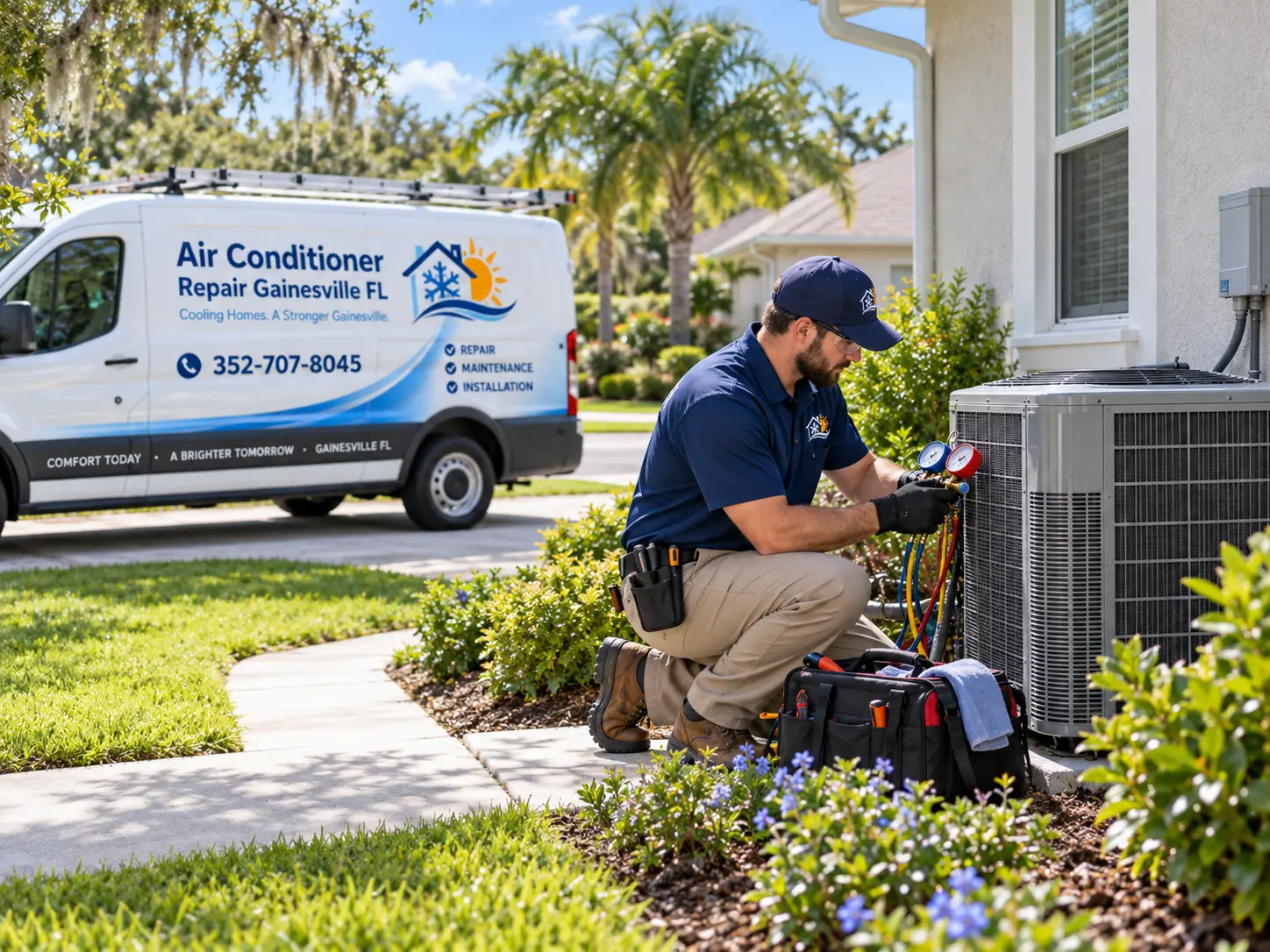
AC Repair
Diagnosis and repair for cooling failures across electrical, refrigerant, airflow and drainage systems.
Learn more →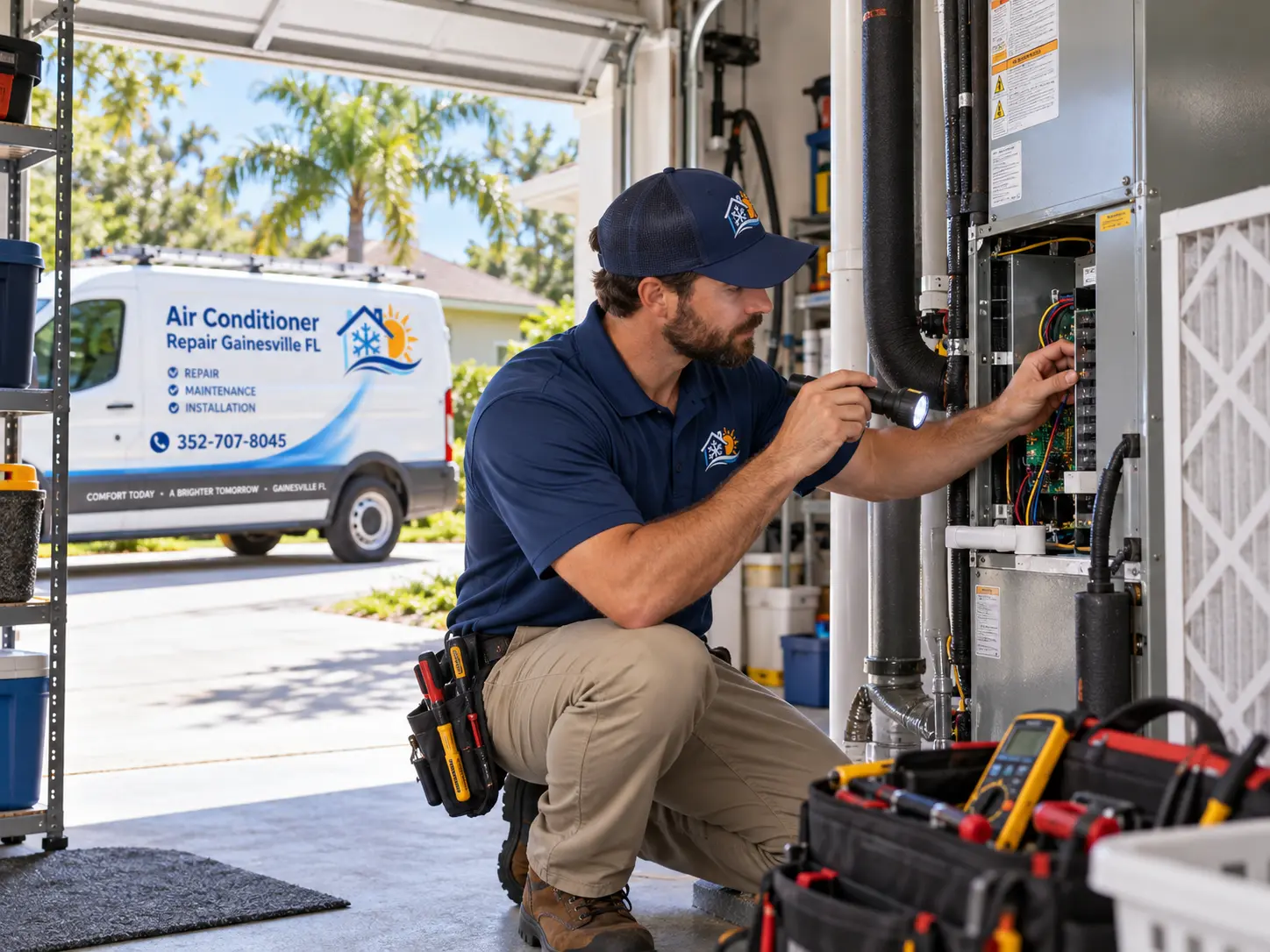
Emergency AC Repair
24/7 request availability for total loss of cooling, water leaks, tripping breakers and alarming noises.
Learn more →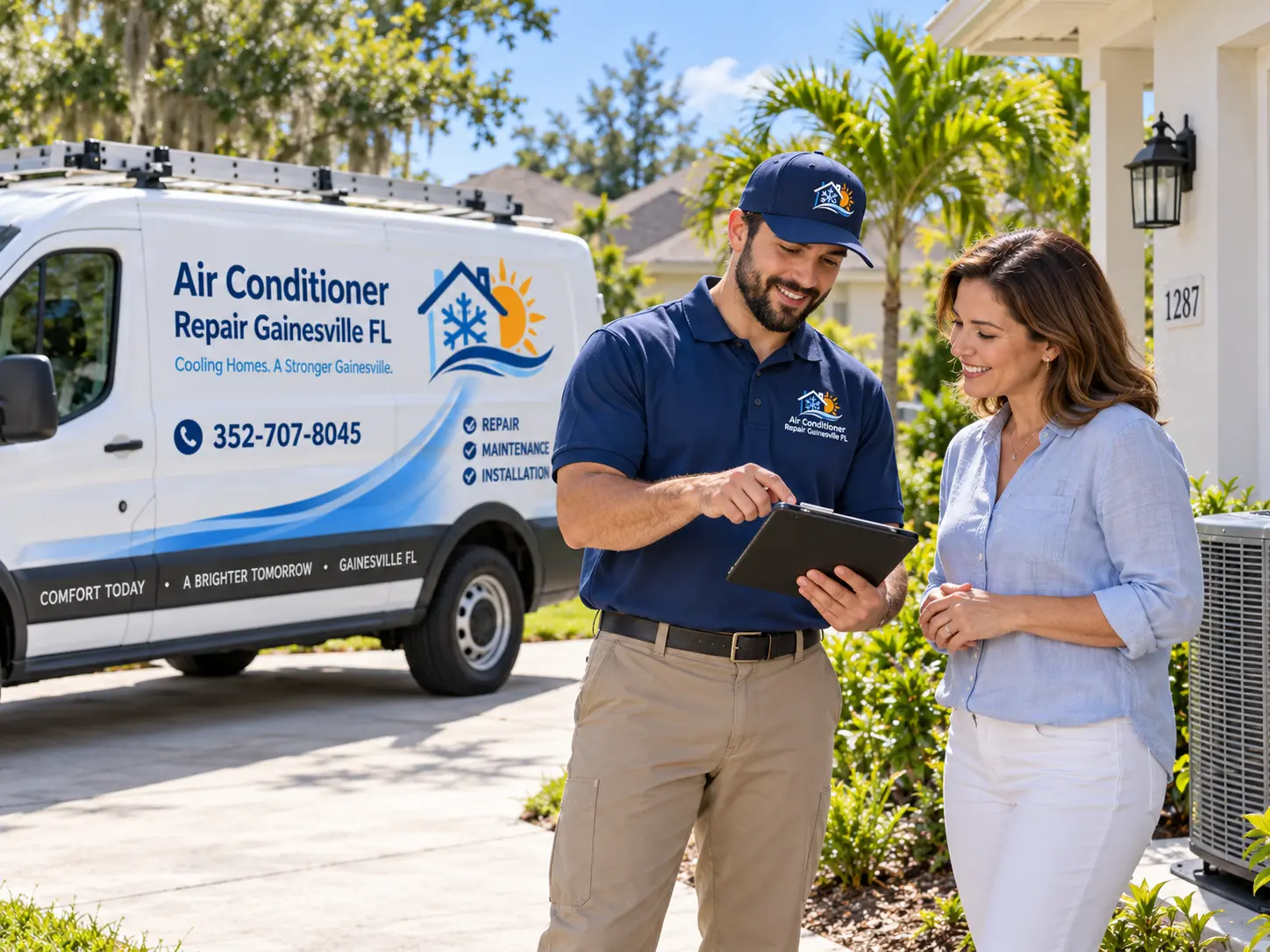
AC Maintenance & Tune-Ups
Coil cleaning, drain service, airflow verification and electrical checks before heavy cooling season.
Learn more →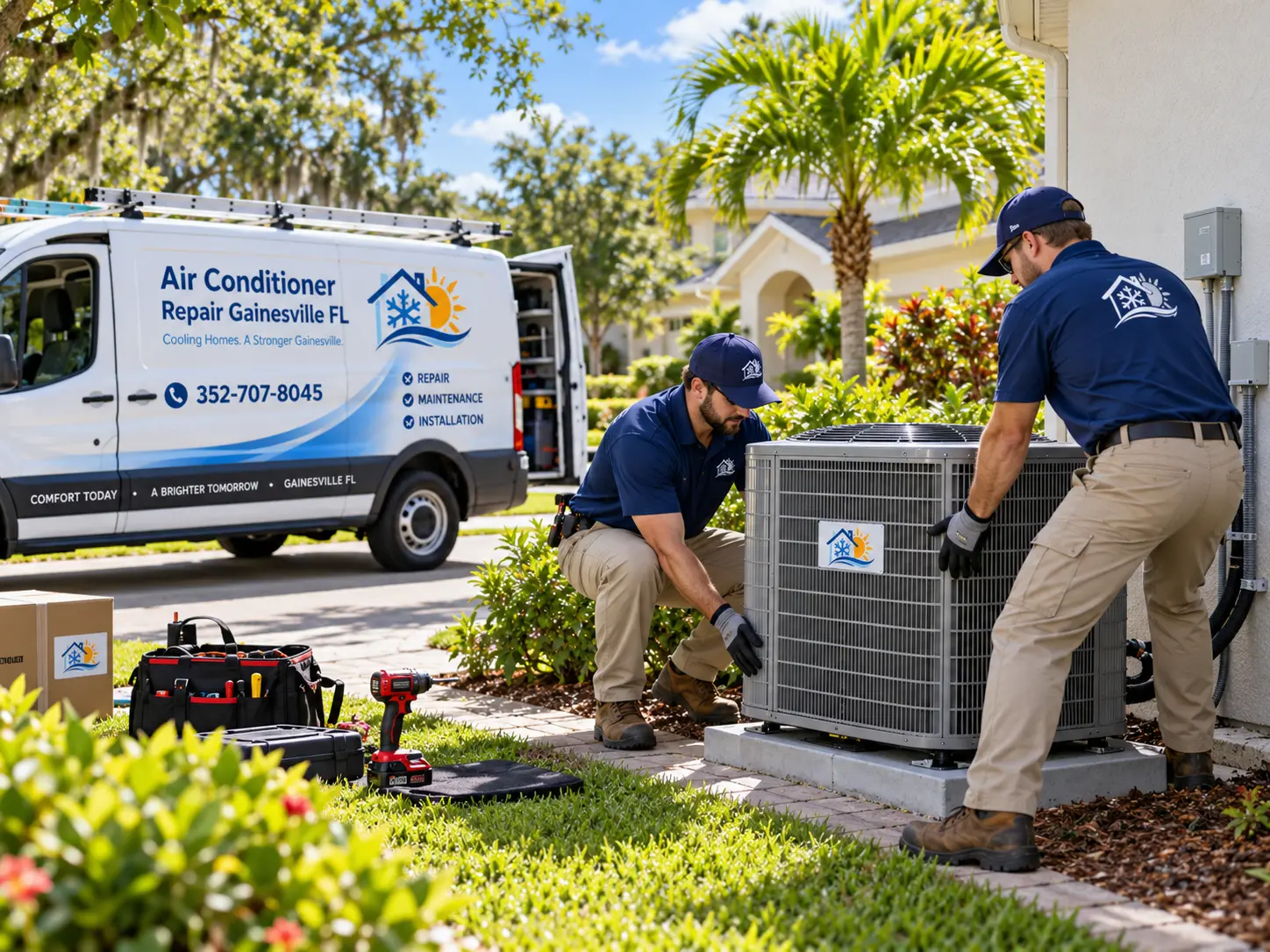
AC Replacement & Installation
Load calculation, duct evaluation and matched equipment — sized for humidity control, not just tonnage.
Learn more →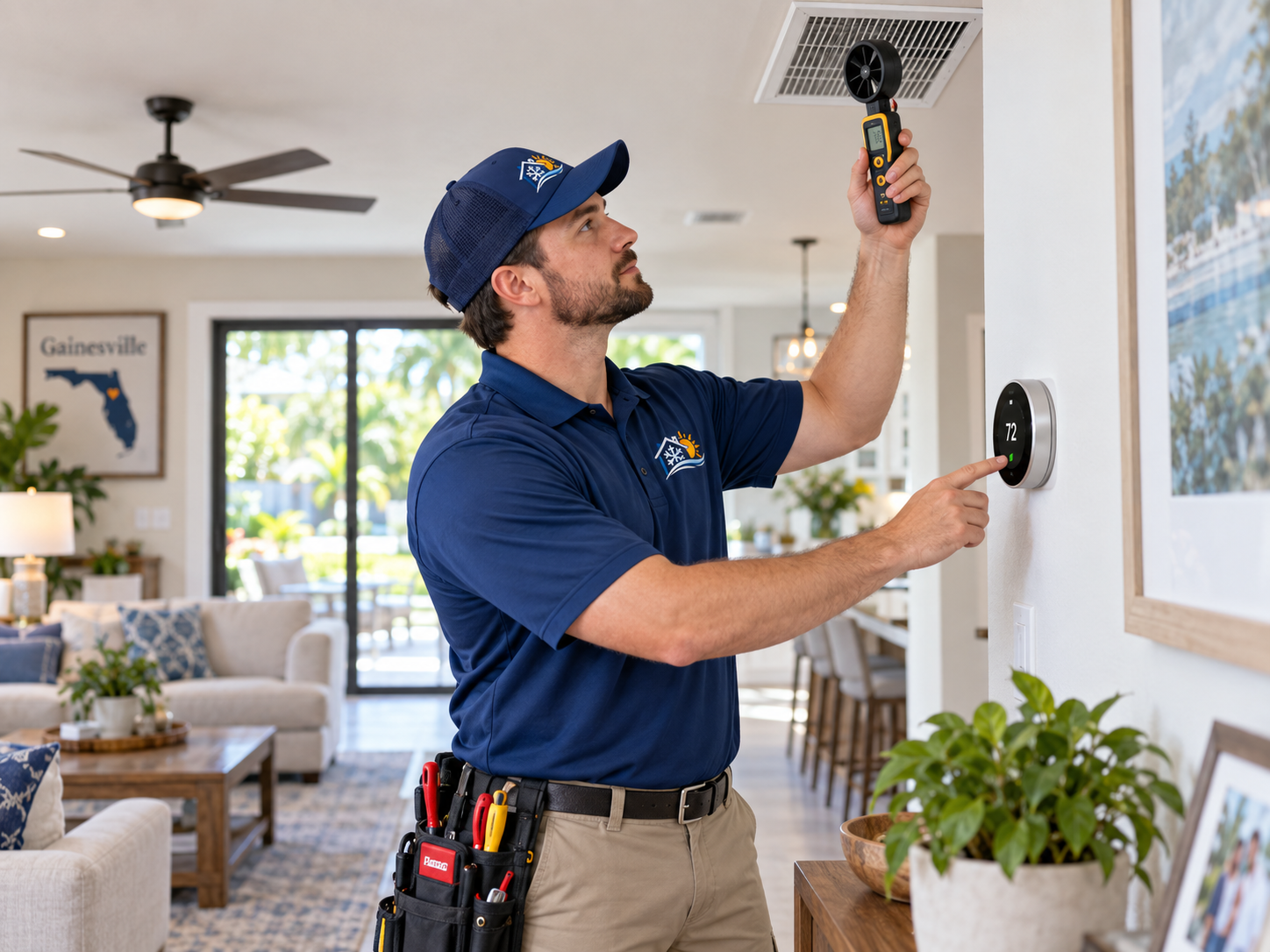
Thermostat & Airflow
Thermostat repair and replacement, airflow measurement and balancing for rooms that never cool evenly.
Learn more →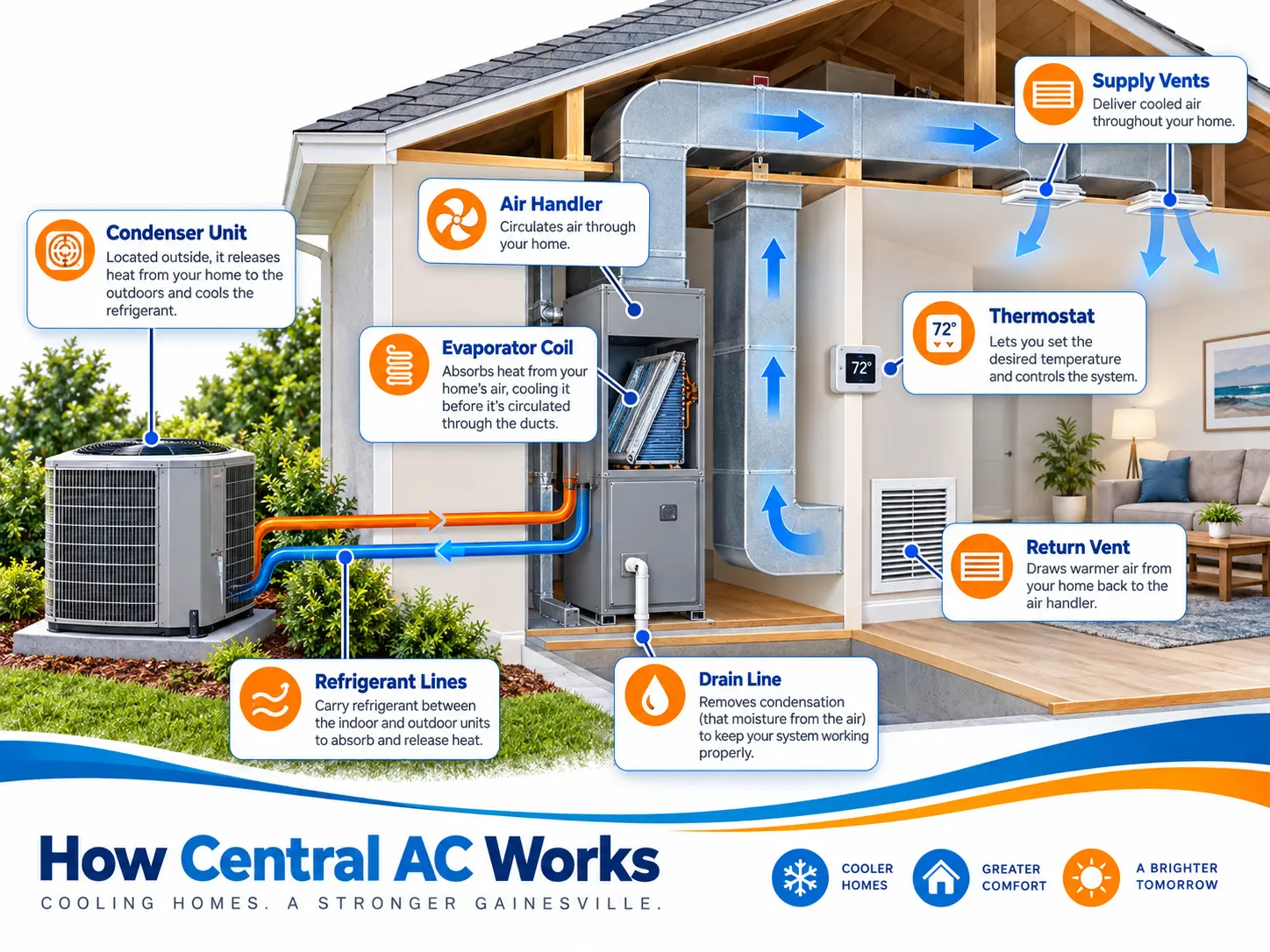
Ductwork & Air Quality
Duct leak repair, return air corrections, filtration and humidity control for Florida homes.
Learn more →Diagnostics
Common AC Problems A Technician Can Diagnose
Warm air at the vents
Weak airflow
Short cycling
Frozen evaporator coil
Clogged condensate drain
Thermostat problems
Unusual sounds
Unusual odors
High indoor humidity
AC will not turn on
Unit runs constantly
Uneven cooling
Local context
Air Conditioning Repair for Gainesville Homes
Cooling equipment here works a long season. Warm, humid stretches keep systems running for months at a time, and that run time is what exposes weak parts — capacitors that were marginal in April fail in July, and coils that were merely dusty become genuinely restrictive.
Moisture is the other constant. A system pulling gallons of water out of the air every day depends on a small PVC drain line staying clear. Condensate drain problems are a common cause of cooling interruptions in humid climates, because the system removes substantial moisture whenever it operates.
Airflow matters just as much. Ducts routed through hot attics lose cooling before it reaches the room, and returns that were undersized when the house was built get worse when a thicker filter goes in.
Outdoor units live outdoors, which in Alachua County means pollen, grass clippings, leaf litter and summer storms. Keeping the condenser coil clean and clear is one of the highest-return things a homeowner can do.
How it works
The AC Repair Process
- 1
Describe the problem
Tell us what the system is doing, when it started and whether there is water, ice or a tripped breaker.
- 2
Schedule or request service
Requests are taken 24/7. Urgent cooling failures during heat are prioritized over routine work.
- 3
System evaluation
Airflow, electrical values, refrigerant performance, drainage and controls are checked with instruments, not guesses.
- 4
Findings and options
You hear what failed, what caused it, and what the repair involves before anything is replaced.
- 5
Repair if authorized
Work proceeds only with your approval, including any related conditions that need correcting.
- 6
Verify cooling and airflow
Temperatures, airflow and drainage are confirmed at completion so the fix is measured, not assumed.
Decision help
Repair or Replace?
No single number decides this. Weigh these factors together — and be skeptical of anyone who claims a fixed lifespan applies to every system.
| Factor | Leans repair | Leans replacement |
|---|---|---|
| System age & condition | Maintained, coils sound | Corroded coils, heavy wear |
| Repair frequency | First real repair in years | Multiple calls recent seasons |
| Repair cost | Small share of replacement | Approaching replacement cost |
| Comfort | Cools evenly when working | Hot rooms, sticky air always |
| Energy use | Consistent with past years | Climbing run time and bills |
| Refrigerant & parts | Current refrigerant, parts available | Phased-down refrigerant, scarce parts |
Cost
What AC Repair Costs Depend On
Any site quoting a firm price for your specific failure is guessing. What can be explained honestly is what moves the number:
- The diagnosis itself — instruments and time to identify the fault
- The failed part, from a capacitor to a compressor
- Accessibility: a garage air handler versus a tight attic install
- Equipment type, age and parts availability
- Repair complexity, especially anything opening the refrigerant circuit
- Timing — after-hours and holiday labor rates are higher
Plan before you commit
The cost guide breaks down each repair category. The estimator turns your symptom, system type, age and urgency into a rough planning range — clearly labeled as an estimate, not a quote.
Service area
Serving Gainesville and Nearby Communities
Requests are handled across Gainesville and Alachua County — Downtown and the Duckpond, the University and Midtown area, Northwest Gainesville and Millhopper, Southwest Gainesville along the Archer Road and Newberry Road corridors, Haile Plantation, and out toward Jonesville, Tioga, Archer, Newberry and Alachua.
- Downtown Gainesville
- Duckpond
- Northwest Gainesville
- Millhopper
- Southwest Gainesville
- Haile Plantation
- Newberry
- Alachua
Education
How Your Central AC System Works
An air conditioner does not make cold air — it moves heat out of your house and removes moisture along the way. Once that clicks, most symptoms make sense: something is blocking heat from being collected, moved or released.
- Condenser unit — releases collected heat outdoors
- Air handler — circulates air through the home
- Evaporator coil — absorbs heat and condenses humidity
- Refrigerant lines — carry heat between the two units
- Drain line — removes the moisture pulled from your air
- Thermostat — starts and stops the whole cycle
Safe checks
Before You Call
These steps are safe, take a few minutes, and occasionally solve the problem outright. At minimum they make the diagnosis faster.
- Verify the thermostat is set to COOL
- Check the temperature setting is below room temperature
- Confirm the thermostat has power — replace batteries if blank
- Inspect the accessible filter and replace it if visibly dirty
- Make sure the indoor HVAC service switch was not turned off
- Check visible supply and return vents for blockage
- Note whether the outdoor condenser is running
- Look for visible water near the indoor unit
Stop and call instead
Do not open energized electrical panels, handle capacitors, bypass safety switches, add refrigerant, perform electrical testing or dismantle equipment. If you notice any of the following, shut the system off if it is safe to do so and call 352-707-8045.
- Burning, hot-plastic or electrical smell
- Smoke, sparking or scorch marks
- A breaker that trips a second time
- Grinding, screeching or loud banging
- Water spreading into ceilings, drywall or flooring
- Ice on the coil or refrigerant lines
Gainesville AC Repair FAQ
- How much does AC repair cost in Gainesville?
- It depends on what failed. A run capacitor on an accessible outdoor unit sits at the low end; coil or compressor work that opens the refrigerant circuit sits at the high end. Accessibility, equipment type, parts availability and whether the work happens after hours all move the number. The cost guide explains each factor, and the estimator gives a planning range before a real diagnosis.
- Do you have 24/7 emergency AC repair availability?
- Yes. Service requests are accepted 24 hours a day, including nights, weekends and holidays. Urgent situations — total loss of cooling in extreme heat, burning smells, repeated breaker trips, significant water leaks — are prioritized. Call 352-707-8045 and describe what the system is doing.
- Why is my AC running but not cooling?
- The blower is moving air but heat is not leaving the house. The usual causes are restricted airflow from a loaded filter or dirty coil, low refrigerant charge from a leak, a dirty condenser coil that cannot reject heat, an outdoor unit that is not running, or a compressor that is no longer pumping properly.
- Why is my AC blowing warm air?
- Genuinely warm supply air usually means the outdoor unit is not operating. Check the thermostat mode, then step outside: a silent condenser points to a tripped breaker, an open disconnect, a failed capacitor or a burned contactor. Severe refrigerant loss can also cause it, as can a system left in HEAT or FAN mode.
- Why does my air conditioner freeze up?
- The evaporator coil operates just above freezing, so anything that reduces the heat reaching it — a dirty filter, fouled coil, weak blower, crushed duct, closed vents — or reduces refrigerant pressure inside it can push it below 32°F. Ice then blocks airflow and makes the problem worse. Thaw it with the fan only, then find the cause.
- Why is water leaking from my indoor AC unit?
- Your system pulls gallons of moisture out of the air on humid days, and all of it has to leave through the condensate drain. Water indoors means that path failed: a clogged line, a failed condensate pump, a rusted drain pan, or melt water from a frozen coil overwhelming the pan.
- What causes an AC breaker to trip?
- A breaker trips when it sees current beyond its rating. Common causes are a shorted or failing compressor, a seized fan motor, a failed capacitor, a damaged wire or a ground fault. Reset it once. If it trips again, leave it off and request service — repeated resets are a fire and equipment risk.
- Should I repair or replace my air conditioner?
- Weigh the repair cost against the equipment's overall condition, its repair history, the refrigerant it uses and how well it has controlled temperature and humidity. Small electrical and drainage repairs rarely justify replacement. Compressor and coil failures on older systems with phased-down refrigerant are where replacement often makes sense.
- How often should AC maintenance be performed in Florida?
- At least once a year for cooling-only systems, ideally before sustained heat, and twice yearly for heat pumps that run in both seasons. Long run times and high humidity here make condensate drain service and coil cleaning far more important than in mild climates.
- Why is my home still humid with the AC running?
- Usually short run times. Oversized equipment satisfies the thermostat before removing much moisture, excessive airflow across the coil reduces condensation, a fan left in ON re-evaporates water from the coil, and return-side duct leaks pull humid attic air into the system.
- What should I check before requesting AC repair?
- Thermostat mode, setpoint and power; the air filter; the indoor service switch near the air handler; the breakers; whether supply and return vents are open; whether the outdoor fan is spinning; and whether there is water or ice. Those observations often shorten the diagnosis considerably.
- Can a thermostat cause an AC to stop cooling?
- Yes. Dead batteries, a lost 24-volt supply, a tripped float switch cutting control power, a broken thermostat wire or a configuration set for the wrong equipment type can all prevent a cooling call from ever reaching the outdoor unit.
- Why does my AC keep turning on and off?
- Short cycling usually means a protective device is tripping: high pressure from a dirty condenser or failed outdoor fan, low pressure from restricted airflow or low charge, or compressor overload. Oversized equipment and thermostat placement also cause it.
- What causes weak airflow from my vents?
- A loaded filter, a dust-caked blower wheel, a failing blower motor, crushed or leaking flex duct, undersized return air, or closed and blocked registers. Static pressure measurement separates an equipment problem from a duct problem.
- What does a refrigerant leak look like?
- You will not see a puddle — refrigerant leaves as a gas. The signs are gradually weakening cooling, longer run times, ice on the suction line, an oily residue near fittings or coil fins, and a system that needed refrigerant before and lost performance again.
- Do you serve areas outside Gainesville?
- Yes. Service requests cover Gainesville and nearby Alachua County communities, including Newberry, Alachua, Archer, Jonesville and Tioga. Travel distance affects scheduling rather than availability.
AC Trouble in Gainesville?
Describe the symptoms and get help scheduling air conditioner repair. Service requests are available 24/7.